Stud selection could be one of the most underestimated decisions a rugby player makes. Every tackle, ruck and run across the pitch demonstrates the difference between the correct stud arrangement for the conditions and the incorrect one. Firm ground rugby boots and their soft ground cousins are not interchangeable, and using them as such can have ramifications throughout a match.
What Soft Ground Actually Means
Soft ground conditions refer to pitches with high moisture content, resulting in softer, more yielding turf. This category includes waterlogged winter pitches, muddy touchlines, and wet pitches after a rainstorm. In these conditions, the boot must penetrate the surface to make stable contact with the firmer ground beneath. Long, metal-tipped studs do this by piercing through the soft upper layer and anchoring to the substrate beneath.
What Firm Ground Conditions Require
Firm ground surfaces are harder, drier, and less susceptible to stud penetration. These include well-kept summer pitches, artificial surfaces with a hard feel, and early-season grass before seasonal rains. Long studs built for soft terrain do not penetrate well and instead sit on the surface, reducing the contact area and creating pressure points under the foot. Shorter, moulded studs distribute the load more evenly and grip the firmer surface without the discomfort that can result from incorrect stud length.
The Consequences of Getting It Wrong
Wearing soft-ground boots on a hard surface is one of the most physically painful aspects of the sport. Each stride generates localised pressure spots where the studs press against the sole without penetrating the surface. After an hour, discomfort can impair running mechanics and focus in ways that are difficult to distinguish from other reasons. More importantly, a lack of appropriate contact between the boot and the surface increases the likelihood of slipping when changing directions or under heavy loads.
Wearing Firm Ground Boots on Soft Pitches
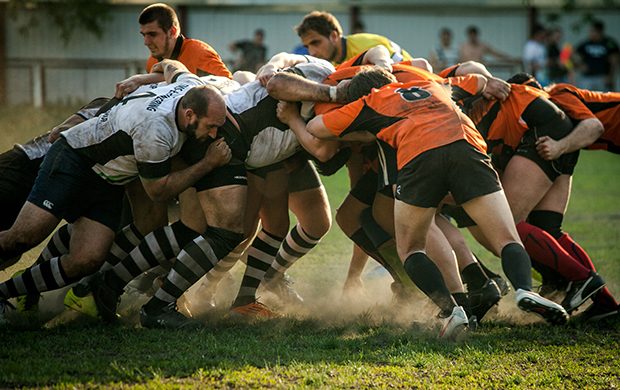
The opposing problem is as destructive. Moulded solid ground studs on a wet field sit above the layer of grip, offering little traction during scrums, lineouts, and driving mauls. A player attempting to push in a maul on a muddy pitch with insufficient stud penetration contributes far less force than their physique should allow. The studs just cannot find the purchase they require, and their entire physical effort suffers as a result.
Screw-In Stud Versatility
Many forward-specific boots have screw-in studs that may be adjusted between sessions based on projected conditions. This versatility is especially useful in regions where conditions change dramatically over the course of a season, or even within a single week of training and match play. Maintaining a set of both long soft-ground studs and shorter firm-ground studs keeps the boot consistent. At the same time, the arrangement adapts to whatever the pitch requires on any given day.
Reading the Pitch Before Kickoff
The ability to effectively estimate surface conditions before a match improves with experience and relies on a few reliable indicators. Walking around the pitch during the warm-up and pressing a thumb into the turf in a few spots gives a good indication of how much give there is. Visible standing water or a surface that clings to boots indicates soft ground. A pitch that sounds firm underfoot and has no wetness at a depth indicates that it is a firm ground pitch.
Hybrid Stud Configurations
Some boots have a mixed stud arrangement, with longer studs at the heel for traction during acceleration and shorter, moulded studs at the forefoot for comfort and agility. These hybrid layouts aim to perform well across a variety of scenarios without excelling in any one of them. A well-constructed hybrid configuration is an acceptable compromise for athletes who own only one pair of boots and need them to perform in a variety of settings throughout the season.
Artificial Surfaces and Their Own Requirements
Many clubs now train or play competitive games on third-generation artificial surfaces. These surfaces have specific footwear requirements since typical studs, particularly metal-tipped ones, are not permitted, and the surface texture presents distinct traction issues. Boots made for artificial surfaces feature small rubber studs or dimpled sole plates that grip the synthetic fibre without destroying it. Using inappropriate boots on certain surfaces voids the warranty on both the footwear and, potentially, the pitch itself.
Stud Length and Player Position
Forwards often benefit with longer studs, even in moderate circumstances, because their game requires persistent pushing and pulling from static positions, where grip depth is more important than it is for backs running at speed. A flanker pushing a maul on a borderline surface will benefit more from longer studs than a scrum-half moving quickly around the breakdown. In addition to surface inspection, position and personal playing style should be considered when selecting studs.
A Simple Decision with a Significant Payoff
Matching stud configuration to surface conditions is one of the simplest ways for a rugby player to improve their performance. It necessitates no additional training, physical conditioning, or technical modifications to technique. It merely involves understanding what each option provides and making the right decision before the battle begins. Players who establish this habit notice that their physical performance in a variety of conditions becomes significantly more constant.