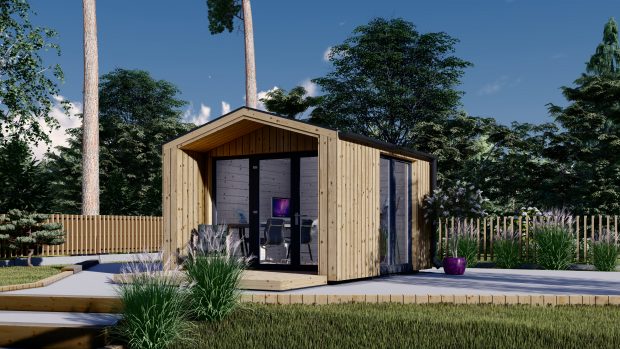
Garden offices are not usually attached to the main home, which makes indoor temperature regulation more difficult. Their exposed structure and lack of shared thermal mass make them vulnerable to excessive heat gain in summer and rapid heat loss in winter.
If these spaces are not thermally designed, they may be unusable for much of the year, creating discomfort and high energy bills. The answer is thoughtful, effective insulation that turns these auxiliary spaces into useful spaces all year.
How Insulation Creates Year-Round Comfort
Insulation works primarily by reducing heat transfer, helping maintain stable indoor temperatures regardless of outdoor conditions. The thermal resistance of a material is measured using its R-value, which indicates how well it resists heat flow.
During winter, insulation retains the heat produced inside a garden office so it doesn’t escape through its walls, floor, or roof. In summer, it acts as a barrier, preventing heat from coming from outside to inside. An insulated garden office maintains stable temperatures with less reliance on heating and cooling systems.
- Insulation slows the transfer of heat to help keep the inside of your home warm in winter.
- It maintains cooler temperatures in summer by blocking solar heat gain.
- Spaces that are insulated can utilize smaller systems.
Insulation can deliver noticeable heating and cooling savings for conditioned accessory structures and similar buildings.

The 3-Layer Thermal Envelope: A Framework for Garden Office Insulation
A successful garden office will have a highly effective insulation strategy known as the 3-Layer Thermal Envelope.
According to this framework, the insulation of the floor, walls, and roof is treated as a single interconnected system. The ideal performance of the insulation materials is based on certain ratios of R-values. For example, the ratio of R-values for floor:wall:roof should ideally be 1:1.5:2. As R-values increase, differences in performance become more significant depending on heat transfer conditions.
Vapor barriers and air gaps are integral to this system, managing moisture and preventing condensation that can degrade insulation performance over time. This integrated approach ensures consistent thermal performance and longevity.
Layer 1: Floor Insulation
The floor plays a vital role in preventing heat loss to the cold ground during winter. Also, it prevents the ground heat from entering the house in summer. It is best to use rigid foam boards such as EPS or PIR for this job with good thermal breaks. In cooler climates, you will generally need at least R-19 or R-30 floor insulation.
Layer 2: Wall Insulation
The walls serve as the primary vertical thermal barrier. Insulation levels for conditioned spaces in moderate climates are typically R-13 to R-20 and should meet or exceed local building standards. Put insulation continuously on the outside to minimize thermal bridging through the studs.
Layer 3: Roof Insulation
The roof undergoes considerable heat gain from solar radiation as well as heat loss. In most climate zones, it usually needs the highest R-values, often R-38 to R-60. The layer affects overall comfort and energy efficiency.
By adopting vapor barriers on the warm side of the insulation and creating air gaps, the roof assemblies can avoid moisture accumulation, improve ventilation and minimize overheating of the roof assembly. This strategy guarantees a dependable performance all year long.
Insulation Materials Compared: What Works Best for Garden Offices
Insulation materials that balance cost, thermal performance, and ease of installation are ideal for garden offices. The choice of material depends on the specific design and intended use of the space.
Rigid foam boards like PIR (Polyisocyanurate) provide excellent thermal performance in a compact format, making them perfect for floors and walls where space is limited. All-purpose closed-cell spray foam provides insulation and air sealing in one application. It’s especially useful for irregular shapes and maximising internal space. It delivers significant energy efficiency improvements in smaller structures.
When it comes to cost-effectiveness, EPS is a good option for the insulation of garden rooms. It provides solid insulation performance at a lower cost. This also makes it the most commonly used insulation in prefabricated builds. Materials like hemp batts are popular due to their sustainable yet breathable nature. They come at a higher upfront cost but are worth the investment.
Real-World Performance: A Year in an Insulated Garden Office
An insulated garden office provides strong thermal stability year-round, making it genuinely usable in all seasons. Unlike uninsulated structures, which experience extreme temperature swings, insulated designs are far more stable.
Year-round, insulated garden buildings typically use far less energy than non-insulated alternatives.
Winter Scenario
An insulated garden office can provide a warm indoor climate with very little extra heating during the cold winter months. The insulation retains heat within the structure and minimises heat loss through the envelope.
Summer Scenario
Air conditioning is not required continuously, and the office remains cool in summer. The use of insulation reduces heat gain which lowers cooling requirements.
Energy Consumption
Well insulated garden offices will require less heating and cooling. Properly insulated spaces where heat pump systems are installed consume far less electricity than direct electric heating, providing further savings.
Humidity Control
The right insulation with vapor control layers helps manage the indoor humidity. This will prevent condensation and mould growth and structural damage, helping to extend the lifespan of the garden office.
Demand for garden spaces that offer insulation as well as usability throughout the year is helping the garden rooms market grow at a steady rate.
Conclusion: Insulation as the Foundation of Garden Office Comfort
Having an insulated garden office is not a luxury; it is the key to a usable, comfortable and energy-efficient space all year round. High-quality insulation and a complete thermal envelope will yield long-term cost savings.
When designing or buying a garden office, homeowners should consider insulation to be the most important thing. A garden office should be treated as a real extension of the home and not just a box in the backyard. With the correct materials and construction methods, a garden office can offer comfortable indoor conditions in all seasons.