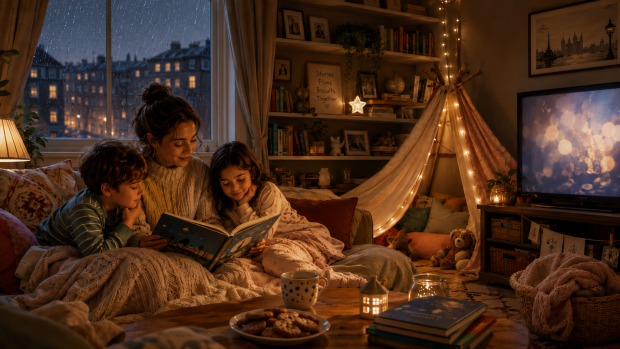
A child climbs into bed and asks for the same picture book again. You already know every line, every pause, every page turn. You could probably recite it in the dark.
Or perhaps it happens on a rainy afternoon. The sky turns grey, plans are cancelled, and without much discussion, the same film is chosen. The snacks are familiar, the jokes land in the same places, and someone always laughs a little too early because they know what’s coming. It feels ordinary, but something is taking shape.
When you repeat the same story at bedtime or put on the same movie when it’s raining, the magic of a story becoming a family tradition is happening.
These moments may seem small, but over time they settle into family life.
Old Favourites Keep Finding New Audiences
Parents have always introduced children to the stories they loved when they were young. What has changed is how many routes those stories now take back into family life.
A book may return as a film, stage production or immersive experience. An older movie can find a new audience through streaming or a cinema rerelease, while familiar characters are regularly reintroduced through adaptations made for a different generation.
These new formats give families a natural reason to explore older stories together. Parents can revisit something familiar without trying to reproduce their own childhood exactly, and children can encounter it through a medium that feels immediate to them.
Repetition Turns Entertainment Into Ritual
The first time a family watches something together, it is simply entertainment. By the fifth time, it may have acquired a date, a routine and a set of expectations.
A film becomes associated with Christmas Eve, the beginning of the school holidays or the first properly rainy Sunday of autumn. A bedtime story develops its own voices and pauses. A theatre visit becomes an annual occasion rather than a one-off treat.
Often, the surrounding details prove more memorable than the plot. There is the blanket fort built before the film, the biscuits decorated to match a favourite book or the exaggerated voice someone always gives to one particular character.
Returning to the same story can also be valuable for younger children. Repetition helps them recognise patterns, become familiar with new words and gain enough confidence to join in. Families rarely return for those reasons alone, however. They do it because the experience feels familiar, comforting and shared.
Stories No Longer End With the Closing Credits
Stories increasingly become starting points for other activities.
A child might draw a favourite character, invent a sequel or recreate a scene using whatever is available at home. A film may inspire a meal, a playlist or a display of figures from Funko UK on the dining room shelf.
These interests can help parents and children understand one another. An adult may not immediately grasp the appeal of a child’s favourite programme, just as the child may not understand why an older film carries so much emotional weight.
London Gives Stories a Life Beyond the Home
London offers families countless opportunities to take familiar stories beyond the living room.
A theatre production can bring out humour or emotion that felt less obvious on the page. Libraries and bookshops allow children to move from one story to another, while museums, workshops and cultural venues invite them to create and participate rather than simply watch.
Some characters are especially well suited to this journey across generations. West London Living’s coverage of The Paddington Bear Experience at London County Hall shows how a familiar figure can become the centre of a contemporary family day out.
Through performance, games and recognisable settings, the experience allows adults to revisit Paddington while children discover his world for themselves.
Children Need Space to Choose Their Own Favourites
It can be tempting for parents to treat beloved stories as essential cultural education. Affection does not work that way.
A child who is repeatedly told that a film is a classic may reject it before the opening scene. A story offered without expectation has a better chance of finding its place naturally.
Some favourites will be dismissed immediately. Others will be enjoyed once and forgotten. A few will take hold for reasons nobody anticipated. Traditions last when children help shape them rather than simply receive them. They may alter the ritual, choose a different version or connect the story to an occasion that means something to them.
Families rarely decide that a tradition is beginning. The significance only becomes clear after the routine has been repeated enough times to feel strange when it is missing.
Years later, people may remember the room more clearly than the plot. They recall who read aloud, where everyone sat or why one character became a running family joke.