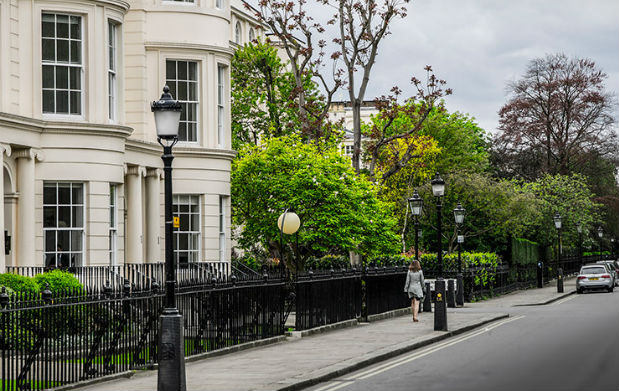
Ask most people to picture West London and you get a decade-old postcard. Notting Hill in pastel. A film crew on Portobello Road. Old money tucked behind a white stucco terrace, the same families it has always been. The picture is not wrong, exactly. It is just about twenty years out of date.
The people who live here now are a different mix, and the money behaves differently too. Some of it arrived. Some of it left. What stayed has quietly changed how the whole area shops, travels and spends its evenings. If you sell to West London, host it, or simply live alongside it, the gap between the postcard and the reality is worth understanding.
The money that came, and the money that went
Prime West London has always pulled in international buyers. What shifted recently is which ones, and how long they stay.
In 2025, roughly 65% of super-prime sellers in London were non-doms leaving the country altogether, heading for Dubai, Monaco, Milan and Geneva after changes to how the UK taxes foreign residents. That is not a small churn at the top. It is a partial change of tenant across some of the most expensive streets in the country. Many did not disappear completely. A good number kept a smaller London foothold, trading the trophy house for something in the £7 million to £10 million range and a base elsewhere.
None of this points to a crash. Forecasters expect super-prime values to soften only slightly through 2026, by around 2 to 3%, with the sharpest wobble reserved for homes near the proposed mansion-tax thresholds. The very top of the West London market is not emptying out. It is turning over. And the people moving in tend to hold their property more loosely than the owners they replaced, which makes the area more international than ever at the top end, and a good deal more transient with it.
The buyers filling the gap are a narrower crowd than a decade ago: Middle Eastern, Chinese, American, and a small but growing number of Turkish purchasers. American interest has been especially strong, helped by a weak pound and super-prime prices that look softer than they have in years.
What they actually spend on
The new resident does not want a project.
A previous generation bought a wreck in Holland Park and spent three years and a fortune putting it right. Today’s super-prime buyer wants move-in-ready: furnished, finished, with a gym, a pool, 24-hour concierge and proper security already in place. Privacy is the premium. A discreet front door and generous proportions now matter more than a famous address on the envelope.
They buy differently in shape, too. A lateral apartment on a single floor increasingly wins out over the classic five-storey townhouse, because a finished, low-maintenance home suits an owner who splits the year across two or three cities and does not want a building to run. The taste has shifted from grand project to easy base.
That preference does not stop at the doorstep. A household that pays for privacy at home tends to want it everywhere: in how it shops, how it travels, how it is looked after, and who it lets in. West London’s service economy has quietly reshaped itself around that instinct, from private chefs and closed-door retail appointments to the discreet, high end companionship services that cater to the same clientele. The common thread is not price. It is discretion.
The evening rearranged itself
The clearest sign of the change is what happens after dark.
The old idea of a night out has thinned considerably. London lost more than 1,100 night-time economy businesses between 2020 and 2023, the steepest fall of any English region, as clubs and late venues closed under rising costs and shrinking footfall. The big, public, anyone-with-a-ticket night is not what it used to be, in West London or anywhere else.
What replaced it is smaller, quieter and much harder to get into. Private members’ clubs have multiplied. London now has around 135 of them, and more opened in the four years to 2024 than in the three decades after the Groucho arrived in 1985. The best restaurant tables get handed out by WhatsApp rather than booked online. Entertaining has moved indoors and behind a membership, out of the public room and into the private one.
For the people who live here, that is rather the point. The money that fills West London now prefers the version of an evening it can control. Known faces. No queue. No phone cameras. Nothing that turns up later in a place it should not.
A quieter kind of money
West London still photographs beautifully. The terraces are the same colours, Portobello still runs on a Saturday, and the school-run Range Rovers still double-park on Elgin Crescent. But the character underneath has moved. The area is more international, more private and more transient than the postcard suggests, with a top layer that arrives furnished and leaves lightly.
For anyone who lives or trades here, the lesson is the same. The West London that rewards you is not the one in the film. It is quieter, harder to read, and it runs on discretion. Knowing who actually lives here now is the difference between speaking to the neighbourhood of 2010 and the one on the street today.