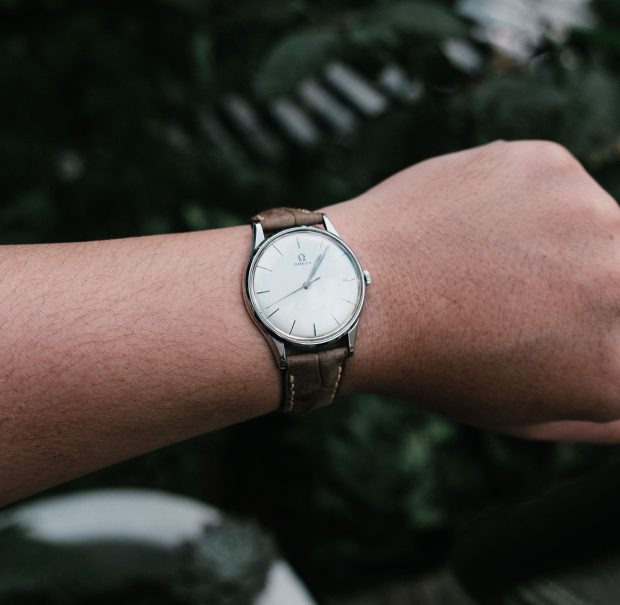
Somewhere between Bond Street and the King’s Road, a fair few of West London’s most photographed wrists are wearing an Omega.
The Speedmaster is having a decade. The Seamaster remains the quiet Chelsea default. The De Ville (thinner, dressier, more restrained) still turns up on Kensington restaurant tables, worn by men who remember when their fathers wore theirs.
Second-generation Omegas are among the most-inherited luxury watches in Britain, and West London, with its old-money postcodes and multi-generational households, holds more than its share.
What almost none of those wearers think about (until they have to) is where the watches actually go when they need servicing.
The answer, for a substantial number of them, is a small workshop about six miles east of Sloane Street, in the London jewellery quarter almost none of West London ever visits. SwissMade has been the official Omega service centre in London for four decades.
It’s one of a small handful of British workshops with manufacturer accreditation from Swatch Group, the Swiss holding company that owns Omega. It’s also, less visibly, the workshop that services many of the Omegas sold through the major Bond Street and Sloane Street retailers.
This is what happens between the boutique and the watch coming back to your wrist.
Why Omegas need dedicated care
Omega movements are among the most technically refined in mass-produced Swiss watchmaking. The current Master Chronometer calibres (the Co-Axial escapements developed since the late 1990s) hold accuracy to within 0/+5 seconds a day and are certified to resist magnetic fields up to 15,000 gauss, which is roughly ten times the level a smartphone can generate.
That precision is remarkable, but it’s also what makes servicing them a specialist job. The Co-Axial escapement’s geometry is different from a standard Swiss lever, and the lubrication schedule is unforgiving. Get the oils wrong and you’ll shorten the movement’s life by half. Get them right and an Omega will run for a decade before its next full service.
The reality is that most independent watchmakers cannot legally source the parts required to service a modern Omega. Swatch Group restricts distribution of factory parts to manufacturer-accredited service centres.
A high street jeweller can replace an Omega battery, but a Speedmaster movement overhaul requires access to hairspring assemblies, cannon pinions and mainsprings that Swatch releases only into its authorised network.
Any workshop offering “Omega servicing” without accreditation is, in practice, either using generic aftermarket alternatives (which void warranty and affect resale value) or shipping the watch elsewhere.
This is not widely explained to the person buying the watch. It becomes relevant, sometimes disappointingly, five or ten years later when the watch stops running, or when the owner tries to sell it and a dealer asks for service records.
A Hatton Garden institution most West Londoners haven’t seen
SwissMade sits at 21–22 Arundel House on Kirby Street, a few minutes’ walk from Chancery Lane. The workshop has been in Hatton Garden since 1985, and in its four decades has serviced more than seventy thousand luxury watches.
The team’s collective experience runs to around two hundred years – a figure that reflects the long tenures common to horology, where watchmakers tend to stay for decades in workshops where the work is interesting.
The workshop’s client base splits 98:2 in favour of the trade. About 98% of SwissMade’s volume comes from the British jewellery industry’s largest retailers; Goldsmiths, H. Samuel, and Watches of Switzerland among them, along with a range of specialist dealers.
When a customer leaves an Omega for service at any of the major UK retailers, there is a strong chance the actual work is being carried out in Hatton Garden.
The remaining 2% is private client work: individuals who send their watches in directly, either through the workshop’s insured postal service or by dropping them off in person. In that segment, a disproportionate share comes from West London postcodes.
There’s a logistical reason for that (the same demographic that buys Omegas in West London tends to hold them for decades and take good care of them) and there’s a service reason: Hatton Garden’s turnaround times are considerably faster than sending the watch back to Switzerland.
A full Omega service through SwissMade typically takes four to six weeks. The same service sent to Swatch Group’s own facilities in Bienne (which is where many high street retailers ultimately route their outsourced work) can take twenty to thirty weeks.
Sometimes longer, if the watch is a vintage reference and needs parts sourced from archive stock. For West London collectors who wear their Omegas daily rather than seasonally, the difference matters.
What “official Omega service centre” actually means
Manufacturer accreditation is not a badge Swatch Group hands out easily.
To be an official Omega service centre in the UK, a workshop has to demonstrate technical competence with the full range of Omega calibres, maintain the specific tooling required for Co-Axial servicing, employ certified watchmakers who have completed Swatch Group’s own training programmes, and operate to the same procedural standards as Omega’s in-house service centres in Switzerland.
The practical consequences for the owner are straightforward. Every full service at an accredited centre includes complete disassembly of the movement, ultrasonic cleaning of every component, replacement of gaskets and worn parts with factory-supplied originals, lubrication to Omega’s current specifications, movement regulation on a timing machine, water resistance testing (to the depth rating stamped on the case back), and final quality control over a seven-day period.
The watch comes back with a two-year international warranty, which is double the industry standard for independent servicing, and matches what you’d get sending the watch to Switzerland direct.
For any Omega owner who cares about long-term movement condition and resale value, that warranty is the point.
It is also, incidentally, why SwissMade’s trade business is so dominant. Major retailers cannot afford to send customers watches to workshops that don’t carry the accreditation and warranty structure the retailer’s own reputation depends on.
The vintage Omega story
Alongside modern servicing, SwissMade runs a dedicated vintage restoration division that handles some of the most interesting work in London horology.
Vintage Omegas (the 1960s Constellations, the pre-1970 Seamasters, the early Speedmasters from before the moon landing) have become a distinct market of their own in recent years, driven by the same cultural shift toward heritage watches that has pushed pre-owned prices to unprecedented levels.
The vintage division’s approach is conservation-first. Original dials and hands are kept wherever possible; period-correct parts are sourced through Omega’s archive network rather than being substituted with modern replacements; patina is preserved rather than polished away.
A Speedmaster from 1968 that comes back looking like it was made yesterday has, in most collectors’ eyes, lost most of what made it worth restoring. The workshop’s vintage team turns down work regularly on those grounds, if a restoration would destroy what’s valuable about the piece, they’ll return it and explain why.
For West London’s second-generation Omega owners (the ones who’ve inherited their father’s Constellation or their grandfather’s early Seamaster) this is often the practical question.
What can be brought back safely, and what is better left alone. The honest answer is usually: more can be restored than owners expect, but restoration is best treated as a preservation exercise rather than a return-to-showroom project.
The West London-to-Hatton Garden connection
The workshop operates a nationwide postal service alongside its walk-in appointments. Clients order a free, fully-insured return pack (cover up to £25,000) through the online portal, pack the watch, and post it via a tracked courier.
Progress can be followed through a customer portal, and the finished watch comes back via insured next-day delivery. For most West London clients, that’s the sensible route: it takes fifteen minutes at home rather than a half-day dropping in and picking up.
For those who prefer to hand the watch over in person, Saturday appointments are available, and the workshop is a straightforward tube ride from Kensington or Chelsea to Chancery Lane.
Some clients treat it as an outing; a service drop-off, a walk through Hatton Garden’s other trades, and a return to a favourite West London lunch. Brother Marcus’s South Kensington branch makes a good bookend for that particular version of a Saturday.
Cost and honest timelines
Full servicing for a modern Omega starts at £175, with vintage restoration priced on application (the range varies significantly depending on parts availability and the extent of the restoration).
Basic maintenance (for a watch in good working condition that simply needs cleaning, lubrication and seal replacement) starts at £80. Battery replacement, for the small number of Omega quartz references, is £50 and completed same-day.
Watches deemed unrepairable are returned free of charge, with no assessment fee. Watches whose repair cost exceeds their value are flagged to the client with a candid explanation and no pressure to proceed.
Both practices are unusual in the wider industry, where assessment fees are common and pressure to proceed with marginal work is a frequent complaint. SwissMade’s forty-year run has, according to its own account, been built on those two points as much as on technical work.
The watch you don’t think about
The Omega worn without thinking about it (the one that goes on in the morning and comes off at night, largely unnoticed) is the watch that has been properly serviced. It runs quietly, keeps accurate time, resists moisture and magnetism, and holds its resale value across decades.
It is also, almost always, the watch that has been through a workshop like SwissMade at the intervals its manufacturer recommends.
For West London’s collectors (the ones inheriting Constellations, the ones wearing Speedmasters to Friday dinners, the ones who bought a Seamaster in Sloane Street a decade ago and haven’t thought about it since) that quiet reliability is the point. It just happens to be built in Hatton Garden.
SwissMade Ltd is located at 21–22 Arundel House, 43 Kirby Street, London EC1N 8TE. The workshop is open Monday to Friday, 9:00–17:30, with Saturday appointments by arrangement. Free insured nationwide postal servicing and trade enquiries: info@swissmade.co.uk.