Brenda Grilli, a content strategist whose work centres on Spanish-speaking digital-entertainment communities, came across the news with the recognition of someone who watches how overstimulated people choose to decompress. A luxury spa had opened in London marketing nervous-system regulation as a purchasable service, aimed not at the sick but at those who are running on diminishing reserves. From her observer vantage, the parallel was immediate. The audiences she tracks reach for online sports betting as one such escape, and she has watched closely enough to know that it stays in the healthy-leisure zone only when firm self-control tools govern it. The guidance resource apuestas.guru is where that audience learns to set those limits, she notes, and the condition it addresses is not so different from what the spa is treating in its own register. Excess, without structure, tips any relief into its own kind of stress.
“The categories differ completely, but the underlying question is the same — what keeps an escape from becoming the thing you need to escape from?”
The spa itself is the latest venture from Ila RegenX, and the reporting behind it, according to The Sunday Times, raises questions worth examining for anyone living in a city and noticing the gap between coping and thriving.
Denise Leicester’s Path from Organic Aromatherapy to Nervous-System Care
Ila RegenX was built by Denise Leicester, whose professional formation spans nursing, midwifery, aromatherapy and reflexology. Nearly two decades ago she launched the Ila range of organic aromatherapy face and body products, a line distinguished by its transparency about ingredients and sourcing. “I wanted to work with growers and farmers, and have the same transparency of provenance as if I were opening an organic restaurant,” Leicester has said. That range was adopted by some of the most respected spas internationally, giving her an established foothold in the luxury wellness world.
In 2020, Leicester opened Maison Ila in the French Pyrenees, conceived as a retreat centred on meditation, yoga and sleep. Then Covid arrived. The guest profile shifted. “Our focus had to change. Suddenly we had guests arriving with long Covid and burnout. And they were informed, they knew about dysregulated nervous systems and mitochondrial health, so we needed to give them something more.” The retreat expanded its methods, adding non-invasive laser acupuncture, an LED red light helmet developed by Weber, sound healing and reflexology to its existing practices.
The London outpost, Ila RegenX, followed. Leicester’s framing for it is deliberate. “We call it a ‘wellness atelier’. We’re here for people who aren’t sick but neither are they full of vitality. People who are functioning but are fatigued.” That positioning distinguishes the space from both conventional medicine and the broader spa industry.
The Science of a System Stuck in Alert
The clinical logic behind the concept begins with the autonomic nervous system, which operates through two complementary branches. The sympathetic branch, associated with fight-or-flight responses, mobilises the body under perceived threat by releasing stress hormones. The parasympathetic branch governs rest, digestion, repair and regeneration. A well-regulated nervous system moves efficiently between both depending on circumstance.
The problem modern urban life creates is chronic. Financial stress, doomscrolling and the relentless stream of phone notifications generate a low-grade sympathetic activation that the body was not designed to sustain over extended periods. The nervous system cannot distinguish a hostile email from a predator. Both register as threat. Both produce the same hormonal response. When that state becomes background rather than episodic, the parasympathetic branch rarely gets adequate time to do its restorative work, and the result is the functional-but-depleted condition Leicester has built her London practice to address.
What the Treatments Actually Do, and What Medicine Says About Them
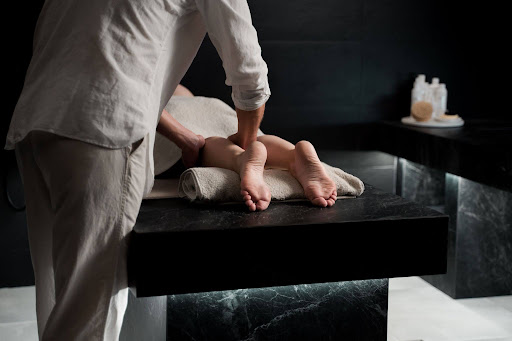
Each visit at Ila RegenX is conducted with privacy as a design principle, with three practitioners attending each guest alongside medical director Dr Nabih Berjaoui. The clinical vocabulary is used precisely, and Berjaoui is careful about what can and cannot be claimed.
Photobiomodulation, or PBM, applies wavelengths of blue, red and near-infrared light to the body. Berjaoui describes it plainly. “PBM, also known as low-level laser therapy, is a regulated medical-device category. And while the strongest evidence sits in pain, inflammation and soft-tissue repair, broader wellness and longevity claims are still emerging.” That distinction between established and provisional matters; the spa makes no attempt to obscure it.
A second technology, delivered by the Human Regenerator, uses cold atmospheric plasma, a partially ionised gas at room temperature containing reactive oxygen and nitrogen species. In Berjaoui’s framing, “it is an established medical-device category in European wound care,” with active areas of investigation extending into dermatology and oncology. The claims attached to it here sit within those credentialled parameters.
Measurement underpins the consultation model. Heart rate variability, or HRV, is assessed using surface electrodes. Berjaoui is direct about its standing. “Clinically, autonomic function is inferred from HRV, and HRV is a properly standardised parameter.” Bioimpedance analysis, which passes a small electrical current through the body via electrodes on hands and feet to estimate body composition, is described by Berjaoui as routine in hospital oncology, renal medicine, sports science and nutrition. Both tools bring clinical rigour to a space that could easily trade in vaguer assurances.
A Consultation, a Result, and an Honest Assessment
When the visiting journalist received her HRV results from Leicester, the verdict was reassuring in its specificity. “Your autonomic nervous system profile is highly encouraging, and reflects a nervous system with strong adaptive capacity, good recovery reserve and healthy autonomic flexibility.” Leicester did note mild adaptive load beneath the surface, a reminder that data of this kind carries nuance regardless of the headline figure.
That detail aligns with the broader framing the piece builds toward. Neuroscientist Dr Andrew Huberman, whose podcast consistently ranks among the most listened-to in the world, is cited in the reporting with a line that functions as both summary and challenge. “Your nervous system doesn’t lie,” Huberman has said. “It reflects the truth of your habits.”
Ila RegenX occupies a townhouse off Harley Street in Marylebone, its three treatment rooms spread across two floors decorated in soft plaster pink with linen curtains and wooden dividers. It is a real address for a condition that, for a growing number of city dwellers, has become equally real.