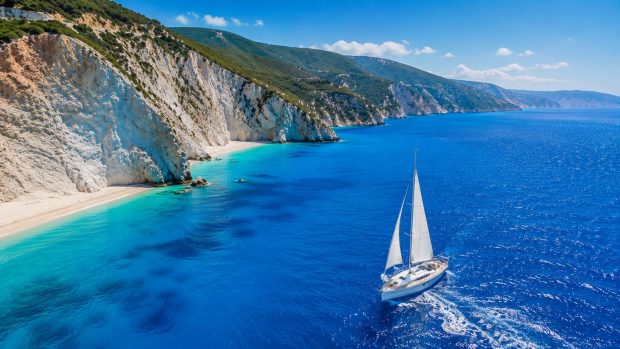
The Ionian Islands sit in calmer water than the Aegean and reward a different kind of summer: less rushing between ferry points, more time in deep bays that open up only when you arrive by boat. Kefalonia is the natural starting point — the largest island in the chain, with the most varied coastline and the most obvious infrastructure for a sailing week. The islands around it — Ithaca, Lefkada, Zakynthos, Paxos, and Corfu — each carry a character different enough to make the wider Ionian worth covering over a fortnight, or worth returning to in separate seasons.
The six sections below cover the best ways into the region, opening with Kefalonia from the water and expanding to five other options across the island chain.
Boat Hire in Kefalonia: The Ionian from the Water
Most of Kefalonia’s best coastline is not reachable by road. Between Fiskardo in the north and Skala in the south, the shoreline breaks into a sequence of limestone coves, sea arches, and white-pebble beaches that only reveal themselves when you approach from the water. Argostoli and Sami are the two main charter bases: Argostoli on the west coast is the more established departure point, with a wider selection of monohulls from entry-level to offshore models; Sami on the east coast is better positioned for routes heading toward Ithaca or down to Zakynthos.
The standard week circuit from either base includes at least one overnight in Fiskardo — the only Kefalonian village to survive the 1953 earthquake intact — a crossing to Vathy harbour on Ithaca, and a day spent finding anchorage in the sheltered bays of the Meganisi group. The prevailing summer wind in the southern Ionian is a northwesterly that builds through the afternoon and dies by evening, giving reliable morning passages and calm nights at anchor. It is a considerably gentler sailing environment than the Aegean meltemi. Charter season runs from late April through mid-October; peak weeks in July and August book early. For current availability and models, browse the Kefalonia boat hire listings for your dates.
Day routes worth adding to any itinerary: the Blue Caves off Fiskardo’s northern headland, the sea entrance to Melissani Lake, and the short passage south to the white-pebble bay at Antisamos.
Ithaca: Homer’s Island on Foot and by Sea
Ithaca is separated from Kefalonia’s east coast by a channel roughly two and a half hours wide in moderate conditions — close enough to include as an overnight stop on a sailing week but self-contained enough to carry its own weight as a standalone destination. The island is small, mountainous, and underdeveloped by Ionian standards, which means the villages have stayed quiet even in high season.
Vathy, the capital and main harbour, sits at the head of a deeply sheltered bay ringed by green hills. The bay is one of the better natural anchorages in the Ionian, and the small town behind it — a single main street, a handful of tavernas on the quay, an archaeological museum with Bronze Age finds — takes less than a morning to cover thoroughly. The interest is cumulative rather than monument-driven.
From Vathy, a network of stone paths climbs to the hill villages of Stavros, Exogi, and Anogi, which hold the oldest settlements on the island and the clearest views across to the mainland. The path to Anogi takes around two hours from the coast; the Byzantine church at the top, with 13th-century frescoes in various states of survival, is a quiet reward. Ithaca works best for travellers who move slowly and do not need a full programme to justify being somewhere.
Lefkada: The Island You Can Drive To
Lefkada is the only Greek island accessible by car — a short causeway connects it to the Akarnanian coast — making it a convenient entry point for the Ionian without a flight or ferry. The island is larger than it looks on a map, and the interior ridge of limestone tops out above 1,100 metres, almost entirely uncrowded.
The west coast is the best argument for the detour. Porto Katsiki and Egremni are the two beaches that appear on most shortlists of the finest in Greece, both backed by sheer white cliffs and facing the open Ionian. Porto Katsiki is accessible by staircase from the clifftop car park; Egremni requires the old stone path (around 350 steps) or arrival by dinghy. Both are better visited before 10 in the morning in July and August.
The charter base at Nidri, on the sheltered east coast, covers routes south to Kefalonia and Ithaca or north to Paxos within a single week. Lefkada also works as a fixed base for day sails to Meganisi, Kalamos, and Kastos — the last two among the quietest inhabited islands in Greece.
Zakynthos: Turtles, Sea Caves, and the Southern Ionian
Zakynthos sits at the southern end of the main Ionian chain and receives more package tourism than its neighbours, but the coastline more than compensates. The island is home to one of the largest nesting populations of loggerhead sea turtles (Caretta caretta) in the Mediterranean, concentrated in Laganas Bay on the south coast. Turtle-watching trips run from the harbour at Zakynthos Town through summer; the nesting season peaks in June and July.
The more dramatic geography is on the west coast. Navagio Beach — the image of a rusted shipwreck half-buried in white sand inside a limestone-walled cove — is one of the most photographed locations in Greece, accessible only by boat. Day-trip boats from Porto Vromi run to the beach in summer; arriving by private charter is quieter and allows more time in the cove before the excursion boats appear. The Blue Caves on the north coast, a series of sea arches and chambers where the water takes on an ultramarine light at noon, make a natural companion stop on the same route.
Zakynthos Town is a post-earthquake reconstruction, but the neo-classical waterfront and the hilltop Venetian fortress above it are worth an afternoon on any trip that includes a port stop here.
Paxos and Antipaxos: Compact, Unhurried, Unarguably Beautiful
Paxos is ten kilometres long and has no airport, which keeps the visitor numbers at a level that feels manageable even in August. The island is largely covered in ancient olive groves — some trees are estimated to be over a thousand years old — and the three small harbours of Gaios, Lakka, and Logos have a quiet, self-sufficient character that the busier Ionian islands have traded away.
Gaios is the main harbour and the operational centre: fuel, provisions, a handful of restaurants, and a small square that fills in the evenings. Lakka, in the north, is a deep inlet better suited to overnight anchoring and is generally considered the quieter of the two main stops. The sailing between them follows a coastline of sea caves and stacks, some large enough to take a yacht inside on calm days.
Antipaxos, two kilometres south, has two beaches — Voutoumi and Vrika — where the water is the kind of turquoise that reads as improbable until you are standing in it. A half-day from Paxos covers both comfortably. Arrive before noon or after 3 pm to avoid the worst of the excursion boat traffic.
Corfu: Architecture, Hillside Villages, and the Northern Ionian
Corfu sits at the top of the Ionian chain and carries a layered history that distinguishes it from the other islands: Byzantine churches, Venetian bell towers, Neoclassical arcades built during British administration, and French-era esplanades all coexist within Corfu Town in a way that earned it UNESCO World Heritage status in 2007. The Old Town is compact enough to cover on foot in an afternoon, but the density of architectural detail rewards a slower pace over two days.
Outside the capital, the island opens into rolling countryside — olive groves, cypress trees, and stone villages on hillsides above the sea. The northeast coast between Kassiopi and Ag. Stefanos is the least developed section, with small pebble coves facing the Albanian mountains across the strait. Paleokastritsa on the west coast, built around sandy coves below a 13th-century monastery, is the standard tourist itinerary and worth the visit if you arrive early or late in the day. For cruising around use this reliable yacht charter in Greece and you will have the best summer holidays.
Corfu is also a viable sailing base for routes south toward Paxos and the main Ionian chain. The channel between the island and the mainland is one of the calmer sailing corridors in the region, and the marinas at Gouvia and Corfu Town are well equipped for charter departures.
The Ionian season is reliable from late May through early October. Peak weeks run from late June through August; September is the local favourite — warm sea, shorter queues, and the olive harvest beginning in the countryside. Any of these six islands holds a week independently; the most satisfying itineraries combine two or three, using a boat to move between them at whatever pace the weather allows.