You have seen it even if you could not name it: a stylised eye with a strong brow, a line trailing from the outer corner and a curling mark beneath. It turns up on jewellery and book covers, and it is thousands of years older than either. The Egyptians called it the wedjat, and London happens to be one of the easiest places in the world to stand in front of the genuine article. None of the stops below charges for entry, and all of them sit within a couple of miles of each other in the centre of town, an easy afternoon out from west London.
What the Eye of Horus actually means
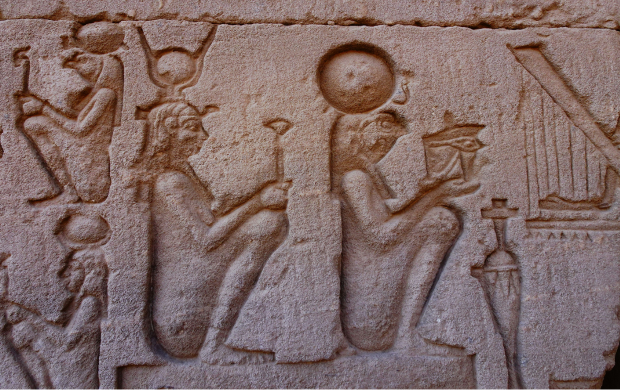
Horus was the falcon god of kingship, and the story of his eye is one of loss and repair. As the Metropolitan Museum of Art summarises the myth, the eye was injured or stolen by the god Seth and then restored by Thoth. The word wedjat means “the one that is sound”, and the restored eye came to stand for healing and rebirth. The design itself blends a human eye with the markings of a falcon, which explains that distinctive curl.
British Museum curators add a further layer. Their collection notes explain that the wedjat is generally thought to be the moon eye, “injured” as the moon wanes and “healed” as it waxes each month. That made it an obvious choice for a protective amulet, and the museum describes it as the most popular of them all.
Start at the British Museum
The British Museum on Great Russell Street is the natural first stop. Entry is free, and the museum’s own visitor page lists opening hours of 10.00 to 17.00 daily, with a later closing time of 20.30 on Fridays. It recommends booking a free ticket in advance, which gives priority entry at busy periods.
Begin on the ground floor in Room 4, the Egyptian sculpture gallery. This is the home of the Rosetta Stone, a decree of 196 BC written in hieroglyphs, Demotic and Ancient Greek. It was found in 1799 and has been in the museum since 1802. Then head upstairs to the Egyptian galleries in Rooms 62 to 64. The museum’s own gallery activity guide points visitors to the amulet cases here, where the Eye of Horus is listed alongside other protective charms. Many of the wedjat eyes in the collection are small pieces of glazed composition in shades of green and turquoise, pierced so that they could be worn.
A symbol that never went away
Part of the pleasure of seeing the originals is realising how little the design has changed. The eye that an Egyptian craftsman shaped in glazed composition well over two and a half thousand years ago is recognisably the one on a modern pendant. It has since travelled into fashion and games of every kind. Blueprint Gaming borrowed it for Eye of Horus The Golden Tablet, a five-reel slot released in 2021 in which the Horus symbol expands to fill a reel. Like every slot it is a game of chance, and its Egypt is a stage set. The museum cases are where the symbol’s real story sits.
Two quieter stops, and one outdoors
If the British Museum crowds are too much, take the short walk north to the Petrie Museum of Egyptian and Sudanese Archaeology on Malet Place, part of University College London. It holds more than 80,000 objects. UCL lists it as free to enter, open Tuesday to Saturday from 1pm to 5pm, with no booking needed for a general visit.
West Londoners have a personal link to the next stop. Sir John Soane, the architect who built Pitzhanger Manor in Ealing as his country retreat between 1800 and 1804, kept his town house at 13 Lincoln’s Inn Fields, and it is now Sir John Soane’s Museum. In the basement lies the alabaster sarcophagus of Pharaoh Seti I, found by Giovanni Battista Belzoni in 1817. Belzoni offered it to the British Museum, which declined the £2,000 asking price, so Soane bought it himself. Hieroglyphs cover it inside and out. The museum says it is normally open Wednesday to Sunday, 10am to 5pm, with free entry and no need to pre-book, though you may have to queue.
Finally, for Egypt in the open air, walk down to Victoria Embankment. Cleopatra’s Needle, a granite obelisk almost 3,500 years old and carved for Thutmose III, has stood beside the Thames since 12 September 1878. According to London Museum, the two bronze sphinxes flanking it were added in 1881.
A few practical points before you set off:
- Opening days differ: the Petrie is closed on Sundays and Mondays, the Soane on Mondays and Tuesdays.
- The British Museum closes from 24 to 26 December.
- Hours and displays can change at short notice, so check each venue’s own website before you go.
18+ only. Treat any game as paid entertainment, never a way to make money. Free, confidential help 24/7: National Gambling Helpline, 0808 8020 133.