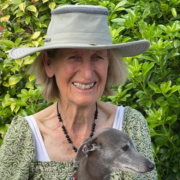
Can you tell us a bit about Ham House Stables, and how it came into your possession?
Ham House Stables is the stable building to Ham House, built, as was the house, in 1610 by Sir Thomas Vavasour. He was Knight Marshal to James I, so he would have had a particular interest in constructing beautiful stables. The side facing Ham House was rebuilt in 1787, so is Georgian in appearance, and much of the interior still exists from this date. The other side is still the original Jacobean architecture, retaining the original features.
In 1948, the Tollemache family gave Ham House to the National Trust but kept the stables. These were then sold in 1957 and came up for sale again in 1978. We were looking for somewhere to buy, and my husband, Martin, was a neurosurgeon based at Charing Cross Hospital, so Ham was within reasonable commuting distance.
We saw an advertisement in the newspaper for “a project with outbuildings to Ham House”. Intrigued, we investigated and immediately fell in love. Initially, we bought the part of the building over the archway where the grooms used to live. Then, when planning permission was refused for the stables and “bothy” cottage, we managed to buy those as well.
I had ridden all my life and done a fair amount of teaching, so I decided to run the stables as a business to pay the mortgage. I also had two little boys and one more on the way, so I could work at home and look after them at the same time.
How would you describe a typical day?
Busy! The wonderful team of staff arrive promptly at 7am. The horses are fed and mucked out, those in the fields are brought in, and horses are prepared for the first lesson at 8.15am.
Lessons run every 45 minutes from 8.15am to 3pm. We have four excellent freelance instructors. The right horse is carefully chosen for the right client, and I am very strict that the horses are not overworked or inappropriately worked. It is not necessary to spoil horses while teaching people to ride. The staff have a lesson themselves at 9.45am every weekday. The horses have lunch at 12pm, tea at 4pm, and another feed and their late hay at 7pm.
In the afternoon, they are groomed, and those who live out at night are taken out. All the horses get turned out in the fields either during the day or at night. Each field has a stable or a field shelter for protection from the weather – a bit like a house and garden to wander in.
Skipping out the stables, filling water buckets, filling hay nets, preparing feeds, and cleaning tack are daily tasks; then, of course, there are all the extras.
I school several horses each morning, teach full-time two and a half days a week, and I’m responsible for all the admin and Health and Safety, which seems to grow monthly. My kitchen is the office, so you are quite likely to find pens and paperclips in the biscuit barrel.
I couldn’t possibly manage without my excellent team of helpers, who go home at 4pm after a very full day.
What did you do before running West London’s premier riding school?
I worked in the art world, initially for a large London fine arts gallery and then preparing exhibitions, photographic sets, etc. I also helped a friend with a small letterpress printing company. We designed the work and hand-printed it using an old Victorian treadle press.
I also edited books and the Riding for the Disabled Association magazine, which I continued doing for many years until 2002.
What guides your eye when you select a horse?
It depends if the horse is for me or for the riding school.
For myself, I like a horse with excellent and athletic conformation — well balanced, with a quick mind and a sense of humour.
For the school, a kind and generous temperament is very important. Good conformation helps because correct work is then easier to achieve and less tiring for the horse. A horse with good conformation is also more likely to stay sound.
Who is your typical rider, and what do you enjoy most about teaching?
We teach both adults and children.
The adults can be busy city workers who are looking for the healing contact with horses and the challenge of working with their body as well as their mind. Clients also come to us looking to experience something more than they can find in a conventional riding school. We follow classical principles and incorporate the Alexander Technique into our teaching. We also get quite a few people who rode as children and want to restart in a more thoughtful way.
I really enjoy teaching riders who take great joy in subtle improvements and a comfortable relationship with the horse. As long as they appreciate the generosity of the horses and realise that good riding improves the horse’s welfare, I am happy.
How do you think riding schools have evolved in recent years?
I do think that, due to our national bodies ABRS and BHS, the standard of care, facilities and teaching in riding schools has greatly improved. The local council licensing system, with annual veterinary inspections, has also helped to raise the calibre. However, running a small business has become more and more financially difficult, and many schools have closed. We have introduced vaulting to our programme, which is great for children and helps because you only need one well-trained horse for a class of up to six children or adults.
What did you do before Ham House Stables — were you always an equestrian?
I was brought up in Dorset, the youngest of four sisters. My father was a top amateur jockey (in India, where we were all born) and my mother was a beautiful horsewoman – she taught us all to ride.
I had a childhood of hunting, Pony Club and competing. I rode at The Horse of the Year Show in our Prince Philip Mounted Games team, the Pony Club Event Championships, and went to the USA on a British Pony Club exchange team.
In the USA, I rode in three-day events, raced and competed in endurance races. I returned to England to event up to international level. While in Southern California (Martin was doing research), I became the 1973 Californian State Endurance Champion.
Back in Britain from 1974 onwards, I competed in eventing and dressage competitions, interspersed with having my sons. I gave up competing in the 1980s, mostly to look after my children and because I no longer enjoyed the competitive scene — and also to run the stables full-time.
Have you always loved horses, and do you have an earliest horsey memory?
I have always loved horses. I don’t remember learning to ride at about the age of two, but I have very happy memories of bouncing along on my first pony, Lady Kate, with my mother pedalling along beside me on her bicycle.
Lady Kate was very wide, so riding bareback was like sitting on a sofa, but you could stand on her back and pretend you were in the circus. I do remember her pulling her head down to eat, causing me to roll off on various occasions. I don’t think it ever bothered me!
What do you love most about your neighbourhood?
I love the river and the open skies – the sunrises and sunsets. The beautiful ancient trees in Richmond Park and the multitude of wildlife are wonderful. The stately Georgian houses around Ham are also very pleasing to the eye. It is a friendly area – quite village-like in character.
Can you describe your perfect weekend?
I love my family, my horses, my dogs, my garden, art, music, reading and walking in the wilderness with unspoiled nature. So I suppose a weekend that included all those elements would be more than perfect.
What has been your proudest equestrian moment so far?
Hard to say!
As a child, winning the high-point cup at the Pony Club gymkhana with Lady Kate. Riding at the Horse of the Year Show with Mickey. As an adult, completing Badminton Horse Trials with Fisherman. Winning my section of the Eastern Canadian Championships with King Brian – then driving through the night to Vermont and winning the Green Mountain Horse Association 100-mile race with Bright Hope the next day. Winning the Haggin Cup for finishing the Tevis Cup 100-mile race with the horse in best condition (4th overall) with Bright Hope. Persuading Intrepid World (“Tippy” – a horse I had for 18 years) that I was a friend.
Now I’m most interested in rehabilitation and helping horses to enjoy their work with the minimum of physical effort on my part – communing with our minds.