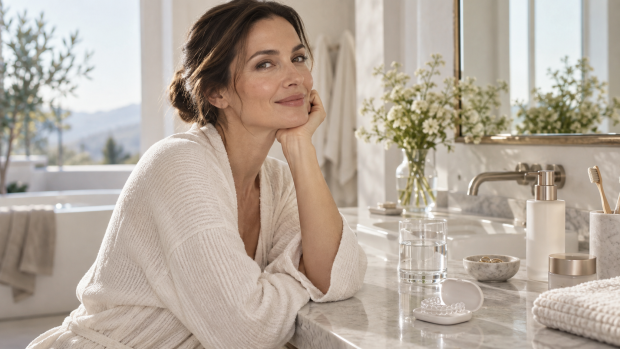
Increasingly, the treatments attracting attention are the ones that are hardest to detect. The aim is less “What have you had done?” and more “You look well.” It is an approach built around gradual improvements, natural-looking results and routines that can quietly become part of everyday life.
Call it quiet beauty: a move away from transformation for transformation’s sake and towards treatments designed to enhance what is already there.
Looking like yourself still matters
The idea is already visible across skincare and aesthetics.
Rather than dramatically changing facial features, many newer treatments focus on skin quality, collagen production and subtle rejuvenation. Even established injectables are increasingly discussed in terms of softer results and retaining natural expression.
Treatments using ultrasound, LED therapy, microneedling and other technologies tend to promise improvement over time rather than an overnight transformation.
That slower approach may sound less exciting on paper, but that is partly the point. Instead of making one dramatic change, the emphasis is on looking fresher while remaining recognisably yourself.
The end of the quick fix?
Social media helped create the age of instant beauty. A treatment could go viral on Monday and have thousands of people searching for appointments by Friday.
There is now a growing awareness that the fastest option is not necessarily the most suitable one.
Good skincare takes consistency. Strength and fitness develop over months rather than weekends. Hair health rarely comes from one appointment. And treatments involving the teeth, skin or facial structure require more thought than buying whatever happens to be trending.
That has made consultations more important.
A useful consultation is not simply an opportunity to choose a treatment. It is a chance for a professional to say whether that treatment makes sense in the first place, what alternatives exist and what kind of result is realistic.
It also introduces something that beauty trends often overlook: maintenance.
A subtle result can still require commitment. Skin treatments may need several sessions. Hair colour needs upkeep. Orthodontic treatment involves wearing appliances consistently and retainers may be needed afterwards. The understated option is not necessarily the effortless one.
A quieter approach to the smile
Dentistry is going through a similar change.
There will always be demand for whitening, bonding and more extensive cosmetic work, but there is also an appeal in treatments that work gradually rather than creating an immediate visual change.
Clear aligners are perhaps the most obvious example. Instead of changing the shape or colour of teeth, they are designed to move them progressively over time.
Dr Shabnam Zai from West House Dental explains “For many adults, the goal isn’t to suddenly look as though they have had a complete smile makeover. They want to improve the function of their bite, or something that has bothered them for a while, but they want the treatment to fit around work, social plans and everyday life. The important part is assessing the teeth first, because the most discreet option still needs to be the right clinical option for that individual – something that looks good, functions well and has longevity in its results.”
Clear removable aligners can be used for a range of mild to moderate orthodontic problems, but also the importance of proper assessment, diagnosis and treatment planning is essential. More complex cases may require additional techniques or a different orthodontic approach altogether.
That makes the consultation part of the treatment rather than an administrative step before it.
Beauty that fits around real life
Research from Phronesis Partners into the behaviour of ultra-high-net-worth consumers found that flexibility, personalisation and seamless experiences increasingly shape perceptions of value. In its analysis, the firm puts it simply: “the highest form of luxury is the removal of effort.”
A treatment may produce impressive results, but if it demands an unrealistic amount of downtime or disrupts daily routines, it can quickly lose its appeal.
That explains some of the interest in treatments marketed around minimal recovery. Recent beauty launches and clinic treatments increasingly emphasise the ability to return to work, exercise or social plans without disappearing for several days.
It fits into a broader lifestyle shift towards services that work around existing routines rather than requiring life to revolve around them.
Instead of simply asking, “What gives the biggest result?”, the question is increasingly, “What result makes sense for me?”
The rise of the long game
Perhaps the biggest change is a willingness to wait.
A generation of beauty consumers accustomed to next-day delivery and same-week appointments is becoming surprisingly comfortable with treatments whose results appear slowly.
Collagen-stimulating procedures can continue developing over weeks or months. Orthodontic changes happen progressively. A good skincare routine may take a season before its effects become particularly noticeable.
There is something appealing about that pace.
Gradual change leaves room to adjust. It can feel less conspicuous. And, importantly, it shifts attention away from a single dramatic reveal.
The polished version of beauty does not necessarily involve looking dramatically different. Sometimes it is better skin after months of looking after it, teeth that have slowly moved into a better position, healthier hair or a treatment subtle enough that nobody thinks to ask about it.
And if someone does notice? “You look well” might be exactly the result you were hoping for.