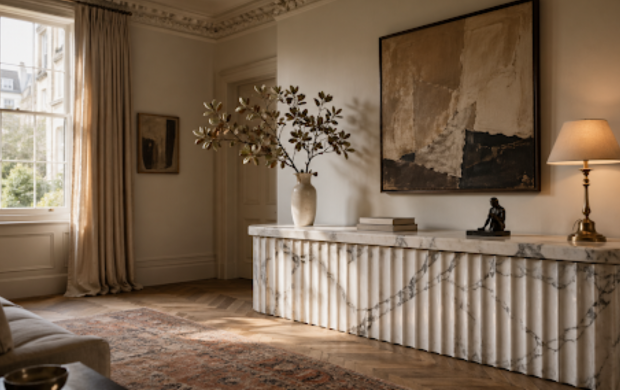
The sideboard, quietly exiled from modern interiors for most of the open-plan era, is back. And it has returned in marble: veined, sculptural, unapologetically heavy. Walk through a recently renovated reception room in Holland Park, or a dining room behind a Notting Hill stucco frontage, and you are increasingly likely to find one anchoring the space. Low, certain, as though it had always been there. After a decade of pared-back rooms and floating console tables, the pendulum is swinging toward furniture that carries weight, both literally and stylistically. West London’s period homes, with their tall ceilings and Victorian proportions, are leading the shift.
The Trend the Numbers Are Confirming
The data tells the same story the showrooms do. Google Trends shows a sustained upward curve in UK searches for “marble sideboard,” “travertine furniture”, and “stone console” over the past eighteen months, with travertine in particular crowned by Porcelanosa’s Trendbook as one of the most coveted materials of the year. Pinterest’s annual Predicts report flagged stone-led, textural interiors among its biggest 2025 home themes, picked up across British titles including Homes & Gardens. Beneath the aesthetic shift sits a structural one: Knight Frank and Savills have both reported lengthening tenure among prime central London homeowners, with renovation spend rising as families stay put rather than move on.
Few pieces capture this shift better than the marble sideboard. Steve Bristow Furniture, a UK-based, family-run maker of handmade natural stone furniture, founded by former artisan stonemason Steve Bristow with more than thirty years of working in marble, travertine, granite and quartz, has seen demand for its sideboard collection rise sharply among London homeowners commissioning pieces for reception and dining rooms.
How a Useful Piece of Furniture Quietly Disappeared
The formal sideboard’s slow exit was less a rejection than an architectural casualty. Open-plan living, which dominated British home design through the 2000s and 2010s, absorbed the room it lived in. Mid-century minimalism rewarded the low, the light and the often flat-pack. The first-time-buyer flat and the rented apartment dictated a more portable aesthetic, pieces that could be carried up a stairwell rather than craned through a sash window. And the kitchen island, with its drawers and bar stools, took on much of the sideboard’s old work: storing, serving, hosting.
The Currents Pulling It Back, in Stone
Several currents are now flowing the other way. Open-plan is giving way to broken-plan layouts, with defined zones and internal glazing, driven partly by working from home and partly by a renewed appetite for distinct rooms. Period homes invite architectural furniture, and homeowners are listening to the buildings again. Houzz UK’s renovation reports have logged a steady rise in spending on bespoke and made-to-order pieces. Natural stone sits comfortably inside the prevailing quiet-luxury aesthetic because it reads as permanent rather than fashionable. Social media has shifted what the eye finds attractive, too: texture and depth now hold attention in a way the flat grey palette of the late 2010s no longer does.
Postcode Geography and the Furniture It Asks For
The geography matters. Chelsea, Notting Hill, Holland Park, and Kensington townhouses were built for furniture of this scale, with high ceilings, formal reception rooms and generous hallways that swallow lighter pieces. Chiswick and Ealing’s Edwardian and Victorian housing stock is increasingly being reimagined with more architectural interiors. In Richmond and Barnes, families staying put longer are renovating for the long haul. West London’s design-aware audience drives demand for furniture that feels commissioned rather than catalogued. The return of entertaining at home, proper dinner parties and hosted Sundays, has also restored a practical case for beautiful serving and storage.
A View from the Workshop
Paul Silk, General Manager of Steve Bristow Furniture, sees the change up close. “Marble sideboards have become one of our fastest-growing categories over the past two years,” he says. “Customers are asking for pieces with visible character now: natural veining, honed edges, sculptural bases. There’s been a clear shift toward bespoke over off-the-shelf, with our London clients scaling pieces to specific room proportions and selecting the stone themselves.”
What’s Actually Going Into These Houses
The choices are narrower than the wider stone market might suggest. Travertine, soft and warm-toned with natural texture, is ideal for lighter rooms. Classic white and cream marbles with dramatic veining, in the Carrara and Calacatta family, remain the safest aesthetic anchor. Darker stones, including Indian Black granite and Emperador marble, are appearing in moodier, layered interiors. Bases tend toward fluted columns, block plinths or minimalist metal frames. Bespoke sizing, built around a specific reception room or hallway, is increasingly the default. Pairing tends to be with warm wood, soft lighting and existing period features, rather than against them.
The Quiet Argument Underneath It All
The sideboard’s return is not really about storage. It is about commitment. A willingness to choose a piece that will sit in the room for decades rather than seasons, and that ages with the house rather than against it. Marble, in particular, captures this moment: natural, permanent, quietly luxurious. The best interiors aren’t the ones most photographed. They are the ones who feel more considered with every passing year.