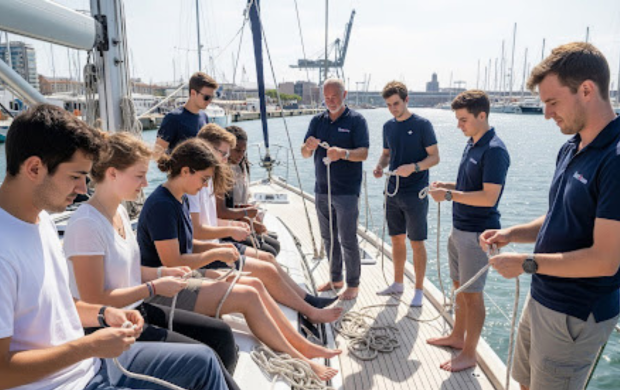
Learning on the water transforms individuals in very silent yet enduring ways. Training on a boat puts responsibility in the hands of a learner and this environment is where awareness, judgement, and calm responses are built by action and not by theory.
From uncertainty to control through structured instruction
Early moments on deck are frequently characterised by hesitation. Instructions come fast, the horizon seems uncertain, and ropes feel strange. By dividing tasks into several phases, guided instruction eliminates that initial uncertainty. Students at Prometheus Sailing School learn about safety procedures, fundamental vocabulary, and crucial handling techniques during the introductory sessions. All of these topics are covered through hands-on activities rather than theoretical explanations. As understanding takes the place of uncertainty, confidence starts to grow.
Technical ability supports mental assurance
Mental and physical coordination is required to operate a boat. Steering, trimming sails and pace adjustment requires attention to detail. Naturally, anxiety declines with technical proficiency. Students gain confidence in their responses when they know how currents can influence the movement or what the wind can do with the canvas. Each successful change builds self-confidence.
Knowledge creates freedom rather than restriction
Clear understandings enable sailors to embrace changes as opposed to being hesitant. The fear of mistakes is removed when one knows why a certain activity is successful. When individuals know the rationale behind manoeuvres, the decisions are deliberate instead of being reactive. Such transformation encourages experimentation with safe supervision, which improves self-reliance and understanding.
Decision making under changing conditions
There are no two outings which are the same. Weather changes, tides change and traffic adds unforeseen variables. Courses replicate these changing conditions, and participants have to evaluate information within a short time frame. Teachers promote decisions made on the basis of observation and reasoning, allowing room for reflection afterwards. Repetition helps learners become comfortable when making decisions.
Responsibility builds self trust
At sea, every successful call is significant. Choosing a course, changing timing, or deciding when to reef increases accountability. Responsibility is accompanied by ownership. People become more confident when they witness the results of careful decision-making, particularly in circumstances where cool-headedness avoids problems.
Communication skills enhance group confidence
Sailing is rarely done solo. Clear communication is essential to the smooth operation of crews. The emphasis of the courses is on situational awareness, active listening, and precise language. Collective confidence grows when communication is better. Participants discover how tension is reduced and operations are kept safe through assertive clarity.
Practical experience replaces theoretical fear
There is little comfort in reading manuals. Proof comes from real experience. Sailing classes put students in authentic settings where their abilities are progressively put to the test. Experience in open water circumstances alleviates excessive concerns. Repetition fosters familiarity, which enables respect and readiness to overcome fear.
Progressive challenges encourage resilience
Training programs become more complicated over time. The calm waters are replaced by the more vigorous winds or night navigation drills. Each step challenges the comfort zones to some extent. A sense of success is not given but is earned, which leads to confidence that is long-term.
Emotional regulation through maritime discipline
Being on the water requires calmness. Emotional responses disrupt rational thinking. Classes teach members to keep their focus even when they are under pressure. Situational scanning, breath control, and regular pacing are learned habits. The practices extend beyond sailing over time, which helps in building confidence in the real world.
Long term impact beyond the boat
The skills gained in sailing training can be used in everyday life. Leadership awareness, problem solving, and measured answers translate into other duties. The confidence that one has attained in the sea is not lost when one goes back to land.
A grounded confidence earned through action
There is no real confidence in taking a risk without preparation. It is formed by learning, performing and reflecting. These elements are combined during sailing courses. By understanding how to think and behave intelligently in the face of perpetual change, people find the confidence in themselves that does not change in any circumstance.